|
1
|
- Providing High-Intensity, Low-Emittance Muon Beams for the Neutrino
Factory and Muon Collider
|
|
2
|
- Future Accelerator Projects Requiring Muon Front Ends
- Neutrino Factory
- Muon Collider
- Choice of Particle – why Muons?
- Design Components and Options
- Research Currently Underway
- By both Grahame Rees and myself
|
|
3
|
- Goal: To fire a focussed beam of neutrinos through the interior of the
Earth
- Constrains post-Standard Model physics
- But why does this involve muons?
- Neutrinos appear only as decay products
- Decaying an intense, high-speed beam of muons produces collimated
neutrinos
|
|
4
|
- p+ à p+
à m+ à e+nenm
- Uses 4-5MW proton driver
|
|
5
|
- Goal: to push the energy frontier in the lepton sector after the linear
collider
- p+ à p+,p−
à m+,m−
à
|
|
6
|
|
|
7
|
- Must accelerate muons quickly, before they decay
- Synchrotron acceleration is too slow
- But once g is high, you have more time
- High emittance of pions from the target
- Use an accelerator with a really big aperture?
- Or try beam cooling (emittance reduction)
- In reality, do some of both
|
|
8
|
- Targetry, produces pions (p±)
- Pion to muon decay channel
- Uses a series of wide-bore solenoids
- “Phase rotation” systems
- Aim for either low DE or short bunch length
- Muon ionisation cooling (as in “MICE”)
- Expensive components, re-use in cooling ring
- Muon acceleration (RLAs vs. FFAGs)
|
|
9
|
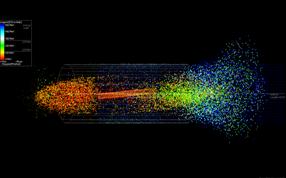
- Has to deal with the “beam” coming from the pion source
- Pion half-life is 18ns or 12m at 200MeV
- So make the decay channel about 30m long
- Grahame designed an initial version
- Used S/C solenoids to get a large aperture and high field (3T mostly,
20T around target)
- Needed a better tracking code…
|
|
10
|
- Developed a more accurate code
- Used it to validate Grahame’s design…
- 3.1% of the pions/muons were captured
- …and parameter search for the optimum
- Within constraints: <4T field, >0.5m drifts, etc.
- Increased transmission to 9.6%
- Increased in the older code (PARMILA) too
- Fixed a problem in the original design!
|
|
11
|
- Chicane (2001)
- FFAG-style magnets
- Shortens the bunch
- Have optimised matching
- No cooling?
- 31.4MHz RF (2003)
- Reduces the energy spread
- Feeds into cooling ring
|
|
12
|
- 10-20 turns
- Uses H2(l) or graphite absorbers
- Cooling in all 3 planes
- 16% emittance loss per turn (probably)
- Tracking and optimisation later this year…
|
|
13
|
- In case the time is longer than my slides.
|
|
14
|
- Accelerators must have a large aperture
- Few turns (or linear) in low energy part, so muons don’t decay
- Recirculating Linacs (RLAs, studied first)
- FFAGs (cyclotron-like devices)
- Grahame is playing with isochronous ones
|
|
15
|
- “Success” is 1021 m+/yr in the storage ring
|
|
16
|
- Distributed Computing
- ~450GHz of processing power
- Can test millions of designs
- Genetic Algorithms
- Optimisation good up to 137 parameters…
- Accelerator design-range specification language
|
|
17
|
- Has to deal with the “beam” coming from the pion source
|
|
18
|
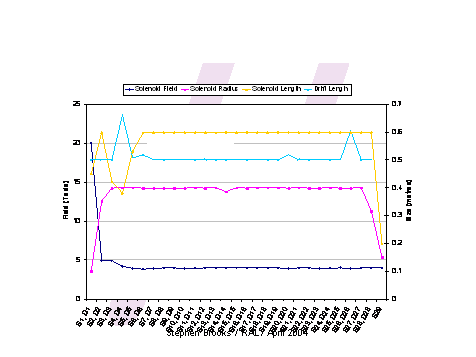
- 12 parameters
- Solenoids alternated in field strength and narrowed according to a
pattern
- 137 parameters
- Varied everything individually
|
|
19
|
- Decay channel:
- Original design: 3.1% m+ out per p+ from rod
- 12-parameter optimisation à 6.5% m+/p+
- 137 parameters à 9.6% m+/p+
- Re-optimised for chicane transmission:
- Original design got 1.13%
- 12 parameters à 1.93%
- 137 parameters à 2.41%
|
|
20
|
|
|
21
|
- Original design had alternating (FODO) solenoids
- Optimiser independently chose a FOFO lattice
- Has to do with the stability of off-energy particles
|
|
22
|
- Nontrivial optimum found
- Preferred length?
- Narrowing can only be due to nonlinear end-fields
|

 Notes
Notes